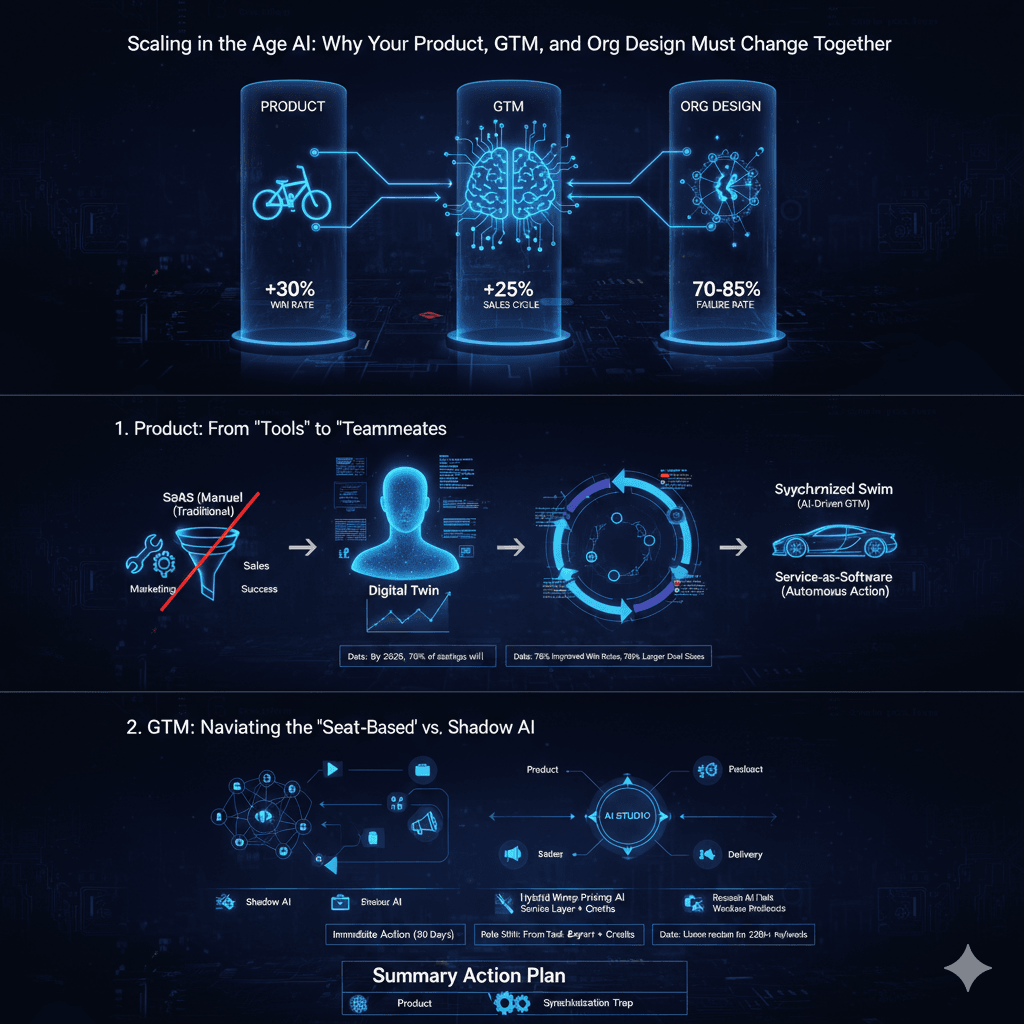
Scaling in the Age of AI: Why Your Product, GTM, and Org Design Must Change Together
The sales landscape is transforming rapidly. AI-powered tools promise efficiency, but many teams find themselves trapped in the same structural breaks they had before: deals stalling, pipelines that look healthy but don't convert, and CRM data that doesn't reflect reality.
When AI is introduced without addressing underlying revenue architecture gaps, it amplifies existing problems. Teams have more tools but the same fundamental issues: lack of agreed value during Discovery, undocumented sales processes, and unquantified Cost of Inaction.
The structural break isn't just in sales execution—it's in how Product, Go-to-Market (GTM), and Organizational Design synchronize. When these three elements don't align, you get the Tri-part Chemical Reaction: Product capabilities that don't match GTM strategy, GTM processes that don't match org design, and org structures that can't execute the product vision.
The Synchronization Trap
The structural break isn't the technology—it's the Synchronization Trap: the disconnect between what your sales process documents and what actually happens in Discovery and close.
The Synchronization Trap occurs when Product, GTM, and Org Design are misaligned:
- Product capabilities don't match GTM strategy (building features buyers don't value)
- GTM processes don't match org design (sales motions that the team can't execute)
- Org structures can't execute the product vision (hiring profiles that don't match required skills)
When AI automates a broken process, you get automated inefficiency. The trap tightens when teams layer AI tools on top of misaligned systems.
The Synchronization Trap in action:
- Your CRM stages don't match the actual buyer journey
- Discovery questions don't surface quantified business impact
- Demo scripts focus on features instead of agreed value
- Pipeline metrics measure activity, not structural health
- Product roadmaps prioritize technical capabilities over buyer outcomes
You're synchronizing the wrong signals across Product, GTM, and Org Design.
The Shift: SaaS to Service-as-Software
The shift from SaaS to Service-as-Software exposes this architectural gap. When buyers expect solutions, not just software, your revenue architecture must surface Agreed Value at every stage.
Service-as-Software means:
- Buyers expect quantified business impact, not feature lists
- Discovery must surface the Cost of Inaction with specific numbers
- Demos must connect features to agreed outcomes
- Close requires documented agreement on business impact
If your sales process still treats buyers like they're evaluating software features, you're operating with a structural break. The shift to Service-as-Software demands a revenue architecture that quantifies impact.
GTM Strategy: The Shift from Access to Results
The pricing conversation is shifting. Buyers are questioning seat-based models when AI handles tasks autonomously. The goal: Transition the reader from selling "Access" to selling "Results."
The ERP & ISV Pricing Challenge
For ERP and Independent Software Vendor (ISV) businesses, the challenge is clear: decouple value from button-pushing.
Traditional seat-based pricing assumes human interaction at every step. However, when AI automates tasks, the "seat" becomes a cost center, not a value driver. Buyers question: "Why am I paying for seats when the AI is doing the work?"
The structural break isn't the technology—it's pricing models that haven't adapted to autonomous capabilities. When your GTM strategy still sells "access to software" instead of "results from automation," you're operating with a Synchronization Trap between Product capabilities and revenue model.
The Hybrid Wrap Model
The solution is the Hybrid Wrap model: maintain mandatory vendor seats but introduce an "AI Service Layer" or "Credit-Based" system for autonomous tasks.
How Hybrid Wrap works:
-
Base Layer: Mandatory vendor seats (traditional foundation)
- Covers human oversight and strategic decision-making
- Ensures accountability and governance
- Maintains relationship structure
-
AI Service Layer: Credit-based or consumption pricing for autonomous tasks
- Decouples AI-driven automation from seat count
- Scales with actual usage, not headcount
- Aligns cost with value delivered
This model allows vendors to:
- Maintain revenue stability through base seats
- Capture value from AI-driven efficiency
- Address buyer concerns about paying for unused seats
Outcome-Based Selling: From Access to Results
The conversation shifts from "How much per license?" to "How much operational cost are we saving?"
Outcome-Based Selling requires transitioning from selling "Access" to selling "Results." The GTM strategy must align with Product capabilities that deliver autonomous value.
The shift:
- Old GTM: "This software costs $X per user per month" (selling access)
- New GTM: "This saves you $Y in operational costs by automating [specific task]" (selling results)
The Discovery conversation must quantify:
- Current operational cost (man-hours, error rates, process delays)
- Projected savings from automation
- ROI timeline with specific numbers
When buyers understand the Cost of Inaction (current operational expense), they see the software as cost reduction, not cost addition. The GTM process surfaces Agreed Value by quantifying the operational cost being eliminated.
This requires Product capabilities that deliver measurable automation, GTM processes that surface operational savings, and Org Design that hires salespeople who can quantify business impact, not just demo features.
The Cost of Inaction
When the Cost of Inaction remains vague, deals stall regardless of how many AI tools you deploy. Momentum stalls because prospects haven't agreed on the quantified business impact.
The measurable cost:
- Win rates remain flat or decline as deals stall after demos
- Sales cycles lengthen when Discovery doesn't surface agreed value
- Pipeline coverage ratios look healthy but conversion rates tell a different story
- CRM data reflects optimism, not structural truth
The structural break isn't the technology—it's the absence of a documented framework that quantifies business impact before the demo.
The Solution: Synchronizing Product, GTM, and Org Design
The solution isn't more technology—it's aligning Product capabilities, GTM processes, and Org Design to surface Agreed Value and deliver Results, not just Access.
The Tri-part Alignment:
-
Product capabilities must deliver measurable automation that reduces operational costs. Build features that quantify business impact, not just add functionality.
-
GTM processes must surface operational savings during Discovery. Transition from selling "access to software" to selling "results from automation." Use the Solution Selling framework: Situation → Problem → Implication (Cost of Inaction) → Need-Payoff (Agreed Value).
-
Org Design must hire and structure teams that can quantify business impact. Sales roles must shift from feature demonstrators to operational cost analysts.
When Product, GTM, and Org Design synchronize around selling Results instead of Access, you escape the Synchronization Trap.
Three steps to fix the structural break:
-
Document your Discovery framework - Quantify business impact before the demo. Surface the Cost of Inaction with specific numbers. Ensure Discovery questions lead to agreed value, not feature discussions.
-
Build agreed value metrics - Create a documented process that connects buyer pain to quantified business impact. Use the Solution Selling framework: Situation → Problem → Implication (Cost of Inaction) → Need-Payoff (Agreed Value).
-
Create a repeatable process - Document the steps from Discovery to close. Ensure your CRM stages match the actual buyer journey. Build AI tools that augment a documented framework, not replace it.
When AI augments a documented framework focused on Agreed Value, you get scalable revenue architecture that adapts.
The 30-Day Action Plan
To implement revenue architecture that adapts to the Service-as-Software shift, follow this 30-day action plan:
Week 1: Document Current State
-
Days 1-3: Audit your current Discovery process. Document every question you ask. Identify where Cost of Inaction is mentioned (or missed).
-
Days 4-7: Map your CRM stages to the actual buyer journey. Identify gaps between documented stages and what actually happens.
Week 2: Build Agreed Value Framework
-
Days 8-10: Rewrite Discovery questions to surface quantified business impact. Focus on "What happens if you don't solve this?" with specific numbers.
-
Days 11-14: Create a documented process that connects buyer pain to Agreed Value. Use the Solution Selling framework structure.
Week 3: Implement Structural Changes
-
Days 15-17: Update CRM stages to match the actual buyer journey. Ensure stages reflect agreement on value, not just activity.
-
Days 18-21: Train your team on the new Discovery framework. Practice surfacing Cost of Inaction with specific numbers.
Week 4: Measure and Adapt
-
Days 22-24: Measure win rates and sales cycle length. Compare to baseline from Week 1.
-
Days 25-28: Identify structural breaks in pipeline data. Focus on conversion rates, not pipeline coverage.
-
Days 29-30: Document what's working. Refine the framework based on real buyer behavior.
Building Scalable Revenue Architecture
Scaling in the age of AI requires revenue architecture that surfaces Agreed Value at every stage. The Synchronization Trap tightens when teams layer technology on undocumented processes.
The shift to Service-as-Software demands documented frameworks that quantify business impact. When AI augments a process built on Agreed Value, you get scalable systems that adapt.
Pricing models must evolve from seat-based to Hybrid Wrap. Discovery conversations must shift from "How much per license?" to "How much operational cost are we saving?"
Your next step: Document your Discovery framework. Surface the Cost of Inaction with specific numbers. Build agreement on quantified business impact before the demo.
When revenue architecture adapts to the Service-as-Software shift, you scale with structural truth, not optimistic data.
Summary Action Plan
| Week | Focus Area | Key Actions | Success Metrics | |------|-----------|-------------|----------------| | Week 1 | Document Current State | Audit Discovery process; Map CRM stages to buyer journey | Baseline: Win rates, sales cycle length, pipeline conversion rates | | Week 2 | Build Agreed Value Framework | Rewrite Discovery questions; Create documented Solution Selling process | All Discovery calls include quantified Cost of Inaction | | Week 3 | Implement Structural Changes | Update CRM stages; Train team on new framework | 100% of deals have documented Agreed Value before demo | | Week 4 | Measure and Adapt | Compare metrics to baseline; Identify structural breaks | Improved win rates and shorter sales cycles |
Pricing Strategy Actions:
- Evaluate current pricing model: Seat-based or value-based?
- Design Hybrid Wrap structure: Base seats + AI Service Layer
- Prepare outcome-based Discovery questions: "How much operational cost are we saving?"
- Document ROI framework: Quantify current operational expense vs. projected savings
Key Questions to Answer:
- What tasks are being automated by AI in your product?
- How do you currently price these automated capabilities?
- Are buyers questioning seat-based pricing?
- What is the quantified operational cost savings your solution delivers?